
QUICK ANSWER
A clear shed and repeatable beat-up are not separate functions. Both must align with weft flight, warp tension and the selected weave so the yarn passes without obstruction and is placed consistently into the fabric.
WEAVING TEAM QUESTIONS
Common checks before configuration
What should the weaving team check first?
Crank or cam shedding is commonly selected for simpler, repetitive weaves and high production continuity. Electronic dobby expands pattern flexibility and heald-frame control. The appropriate system depends on weave repeat, number of frames, yarn behavior and output plan rather than on option count alone.
Can the same settings or configuration be used for every fabric?
No. Air-jet weaving is a coordinated process. Yarn behavior, fabric construction, reed width, shedding system, air supply and production target can change the correct configuration and process window. Use verified project data and controlled trials instead of copying fixed values.
SHEDDING CHOICE
Match the opening system to the weave
Crank or cam shedding is commonly selected for simpler, repetitive weaves and high production continuity. Electronic dobby expands pattern flexibility and heald-frame control. The appropriate system depends on weave repeat, number of frames, yarn behavior and output plan rather than on option count alone.
SHED QUALITY
Create enough clearance without unnecessary warp stress
Heald-frame leveling, timing, stroke, warp-line geometry, heddle condition and warp preparation determine whether the shed is clean. Opening too little or too late can obstruct the pick; excessive motion or tension can increase warp stress and vibration. Settings should be judged from yarn clearance, stops and cloth quality together.
BEAT-UP MECHANISM
Repeat the same reed motion at every pick
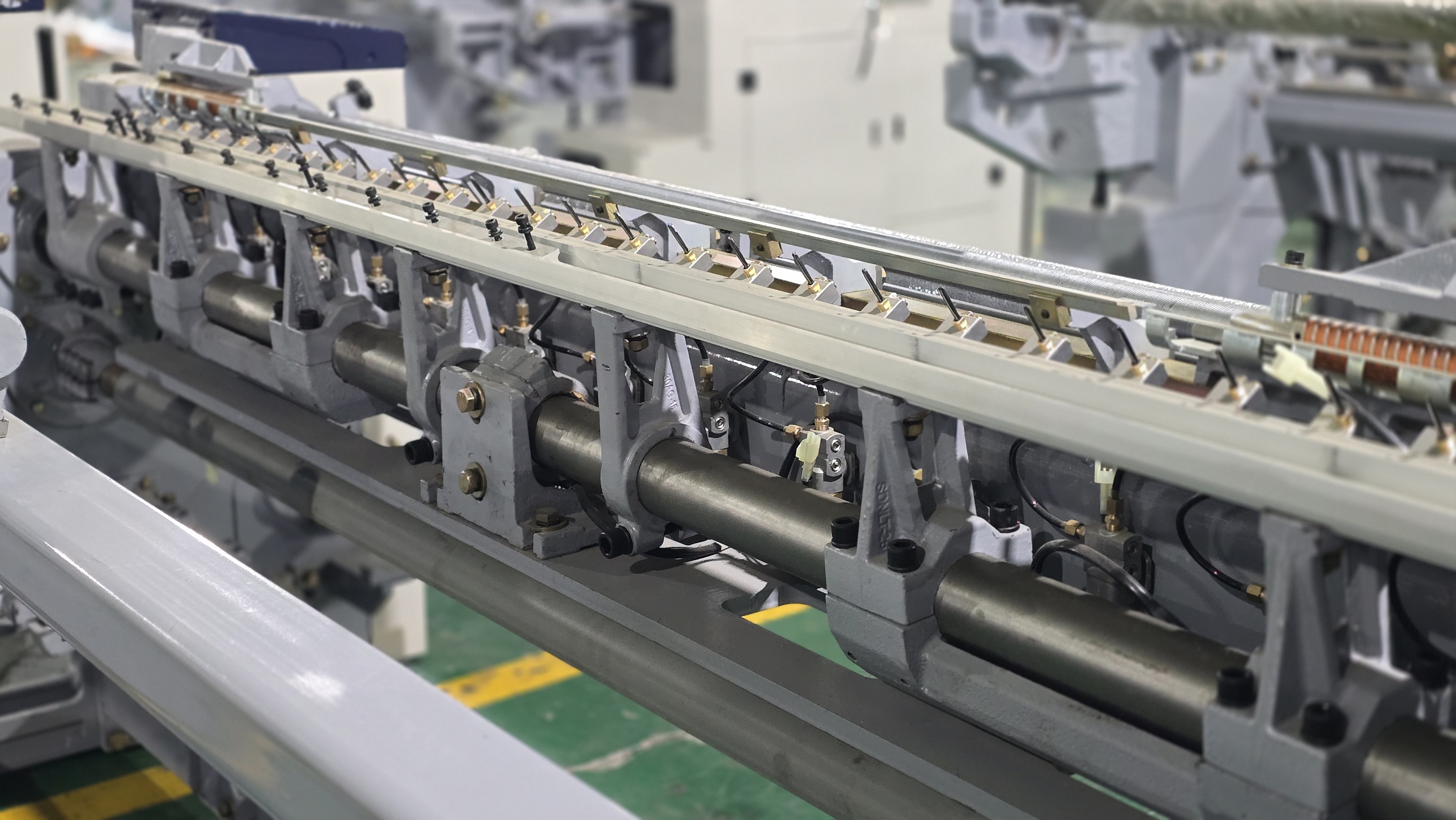
The sley carries the reed forward to press the inserted pick against the cloth fell and then returns to provide insertion space. Shaft rigidity, dynamic balance, bearing condition and connection accuracy influence reed alignment, vibration and the uniformity of beat-up force. MG9200 Max uses JETMECH's integrated beating-shaft design as the mechanical core of this motion.
INSPECTION
Treat vibration or timing drift as system evidence
Abnormal noise, increasing vibration, uneven reed clearance, hot bearings, lubricant problems or unstable heald motion require inspection before production continues. After cam, linkage, shaft or timing work, verify rotation by slow motion and a controlled trial before returning to production speed.
Confirm the shedding and beat-up configuration together
Send the weave repeat, heald-frame requirement, yarn data, reed space and target fabric. JETMECH can explain the suitable shedding and beating arrangement for the project.